Orthodontic Treatment
Non-surgical underbite correction and jaw alignment for growing children.

Face mask protraction headgear is a proven non-surgical treatment for underbites (Class III malocclusion) in growing children. By applying gentle forward traction on the upper jaw during critical growth years, the face mask guides proper jaw development — often eliminating the need for jaw surgery later in life.
Book Your Child's ConsultationFirst, an intraoral appliance — often a rapid palatal expander (RPE) with hooks — is bonded to the upper teeth. This serves as the anchor point for the face mask's elastic traction.
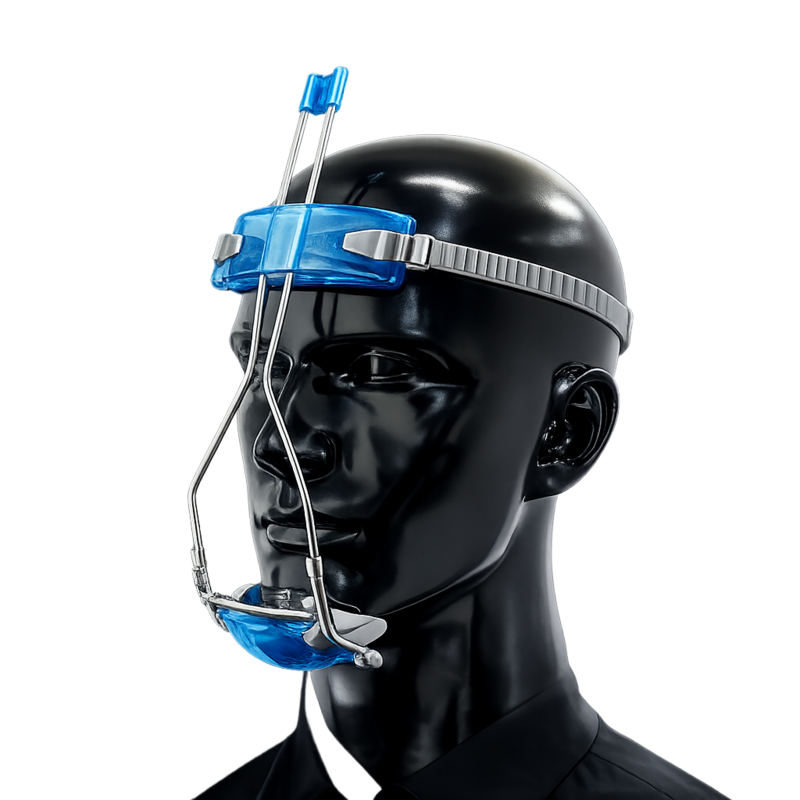
The external face mask frame rests on padded contact points at the forehead and chin. Heavy elastics connect from the frame to hooks on the intraoral appliance.
The elastics apply gentle, continuous forward force on the maxilla (upper jaw), encouraging it to grow forward and correct the underbite. Worn 12-16 hours daily, primarily evenings and overnight.
Treatment lasts 6-14 months with regular check-ups every 4-8 weeks. After the jaw relationship is corrected, patients transition to Phase 2 orthodontics (braces or Invisalign) for final alignment.
Face mask therapy corrects underbites without surgery in approximately 75% of cases when started during growth years. Early treatment can eliminate the need for orthognathic jaw surgery later.
Rather than forcing bones into position, the face mask works with your child's natural growth patterns to guide the upper jaw forward — producing stable, lasting results.
Correcting a skeletal underbite during growth years improves facial balance and profile. The upper jaw moves into proper alignment with the lower jaw for a harmonious appearance.
Early face mask treatment can prevent the need for costly jaw surgery ($20,000-$80,000) later in life. Interceptive orthodontics is a fraction of the cost of surgical correction.
The upper jaw is actively growing during this period. Starting treatment before age 10 maximizes the chance of full correction. The American Association of Orthodontists recommends evaluation by age 7.
Children diagnosed with skeletal Class III malocclusion — where the upper jaw is underdeveloped relative to the lower jaw — are primary candidates for face mask therapy.
Children with a flat or concave midface profile caused by an underdeveloped upper jaw benefit from forward protraction to encourage maxillary growth.
When the lower front teeth bite in front of the upper front teeth due to a jaw discrepancy rather than just tooth position, face mask therapy addresses the skeletal cause.
Face mask therapy is completely non-surgical and works with natural growth. Orthognathic jaw surgery requires general anesthesia, bone cuts, wiring, and weeks of recovery.
Face mask treatment during childhood prevents the problem from worsening. Jaw surgery is only performed after growth is complete (age 17-21), meaning years of living with the underbite.
Face mask therapy costs a fraction of jaw surgery. Orthognathic surgery can cost $20,000-$80,000 including hospital fees, anesthesia, and braces, compared to face mask treatment at $3,000-$6,000.
No recovery downtime with face mask therapy — children continue school and activities normally. Jaw surgery requires 6-12 weeks of recovery with a liquid/soft diet and restricted activity.
A face mask (reverse pull headgear) is an orthodontic appliance that corrects underbites by applying gentle forward pressure on the upper jaw. It has padded support on the forehead and chin, connected to an intraoral appliance with elastics.
Ages 6-10 are ideal, while the upper jaw is still actively growing. Treatment before age 10 has approximately 75% success rate. The upper jaw slows growth around age 8-9.
12-16 hours per day, primarily during evenings and overnight while sleeping. Treatment typically lasts 6-14 months depending on underbite severity and compliance.
Yes. In approximately 75% of cases started during growth years, face mask therapy corrects the underbite without surgery, significantly reducing or eliminating the need for jaw surgery later.
Mild soreness and pressure are common during the first few days. Orthodontists recommend gradually increasing wear time — starting at 1 hour and adding 1 hour per day. Discomfort resolves quickly.
After the jaw relationship is corrected, most children transition to Phase 2 orthodontics (braces or Invisalign) around age 11-13 to align permanent teeth within the corrected jaw.
Team Dental offers face mask protraction headgear treatment across 5 locations — New York City, Philadelphia, Swedesboro, Ponte Vedra Beach, and Vermont. Early orthodontic evaluation is recommended by age 7.
We accept 40+ insurance plans including Aetna, Cigna, Delta Dental, MetLife, and United Healthcare. Flexible financing available.